 Bündeln & Sparen
 Camping Chair
 Hängematten
 Tote Bag
 Cooler & Coffee Cup
 Strandtuch
 Kapuzenhandtücher
 Picknickdecken
 Bags & Backpacks
 Cooler Backpack
 Daunendecken für den Außenbereich
 Rucksack, Plane und Insektennetz
5 Simple Ways Travellers Can Offset Their Carbon Footprint

Travelling the world is one of the great joys of being alive. It's also, if we're being honest, one of the more carbon-heavy things most of us do in a year. A single long-haul return flight can generate more CO₂ than driving a car for several months, and that's before you factor in the hotels, hire cars, and the questionable airport shopping habits many of us have developed.
Thankfully, you don’t need to stop travelling to reduce your carbon footprint. You just need to travel smarter, and that means understanding your own personal carbon footprint and then reducing it. Not sure where to start? Well, lucky you have us to give you some handy hints on 5 simple ways you can reduce your carbon footprint when you travel.

What is a Carbon Footprint?
Ok, first things first: what is a carbon footprint? It’s not a silly question. It’s a term that gets thrown around a lot, but often with little explanation as to what it actually is.
Your carbon footprint is the total amount of greenhouse gases your actions produce, measured in CO₂ equivalent (CO₂e). For intrepid travellers, that tab is dominated by flights, followed by accommodation, ground transport, and food – roughly in that order.
To put the numbers in context: the global average carbon footprint sits around 4 tonnes of CO₂e per person per year, but unfortunately, Australians tend to average closer to 15 tonnes (yikes).
A Sydney to London return flight produces somewhere between 3.5 and 5 tonnes per passenger in economy, which means a single trip can represent more than a year's worth of the global average. Business class produces two to four times that per passenger, because those seats take up significantly more floor space and therefore a bigger share of the aircraft's total fuel burn.
How to Measure Your Carbon Footprint
Before you can reduce your carbon footprint, you need a rough sense of what you're actually working with. A carbon footprint calculator is the most practical starting point. You can use this simple tool from My Climate to see a detailed breakdown of your current carbon footprint.
How to Reduce Your Carbon Footprint When Travelling
-
Fly less often, but go further when you do
The most effective carbon footprint reduction move is also the most obvious one nobody particularly wants to hear: take fewer, longer trips instead of constantly dipping in and out of the country. Four separate weekend trips overseas carry a significantly higher combined footprint than one big trip to the same destination. So wherever possible, it's worth combining destinations into a single itinerary. When you do fly, economy class is the considerably lower-impact choice. Those extra centimetres of legroom in business come at a real emissions cost!
-
Take the train
For short-to-medium distances, trains are the greener option. The London to Paris comparison is a good illustration of the gap: a flight produces roughly 55kg CO₂e per passenger, while the Eurostar produces around 3kg for the same trip, drops you in the city centre, and skips the whole airport experience entirely. Within Europe, Japan, or the UK, ground transport should be your default rather than your backup plan.
-
Stay somewhere that earns the "eco" label
Large chain hotels are energy-intensive by design, and a lot of their sustainability claims don't hold up to much scrutiny. Smaller, independently owned accommodations tend to have a lower footprint, and properties that hold certifications like EarthCheck, Green Key, or B Corp have had those claims independently verified rather than just written about nicely on their website.
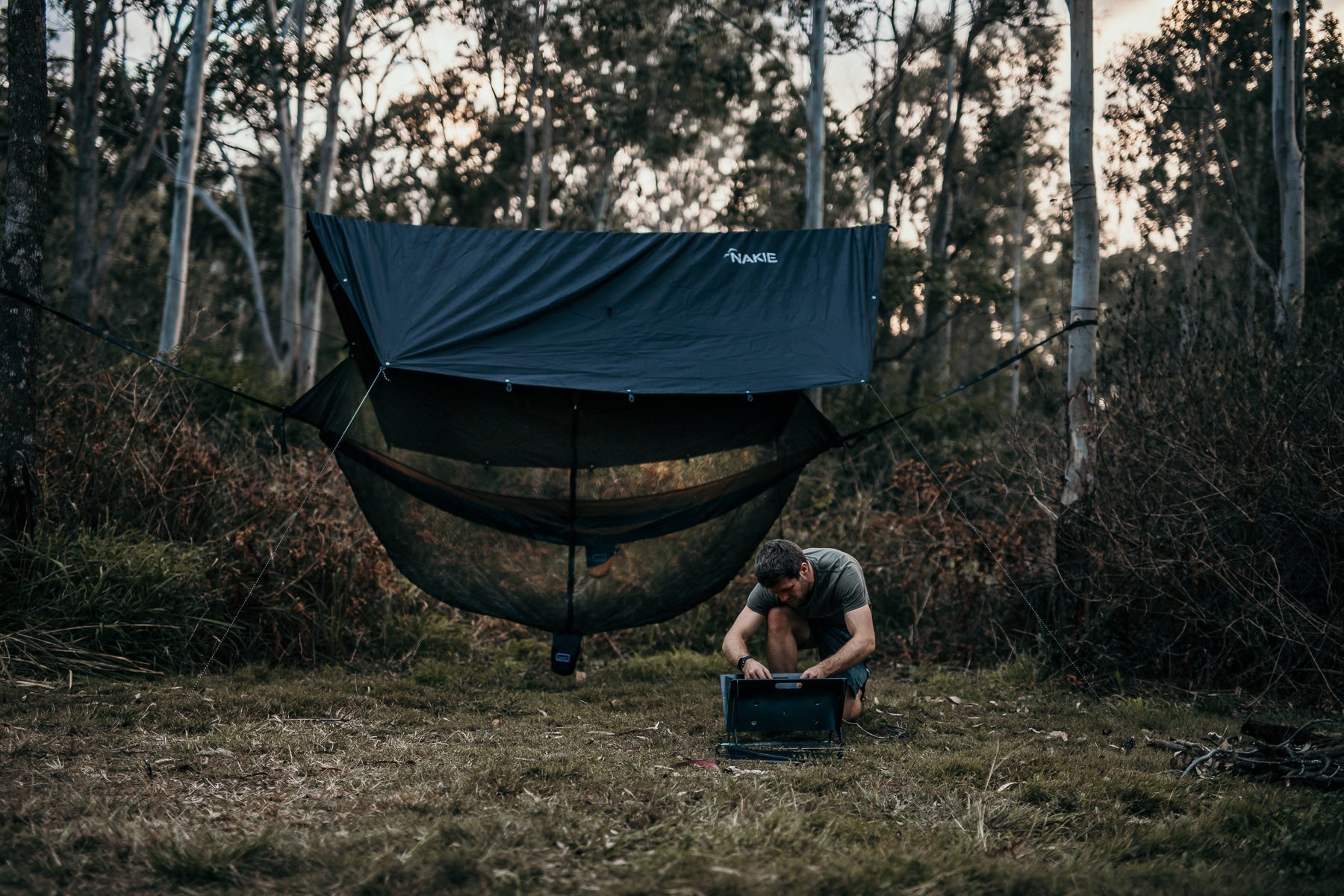
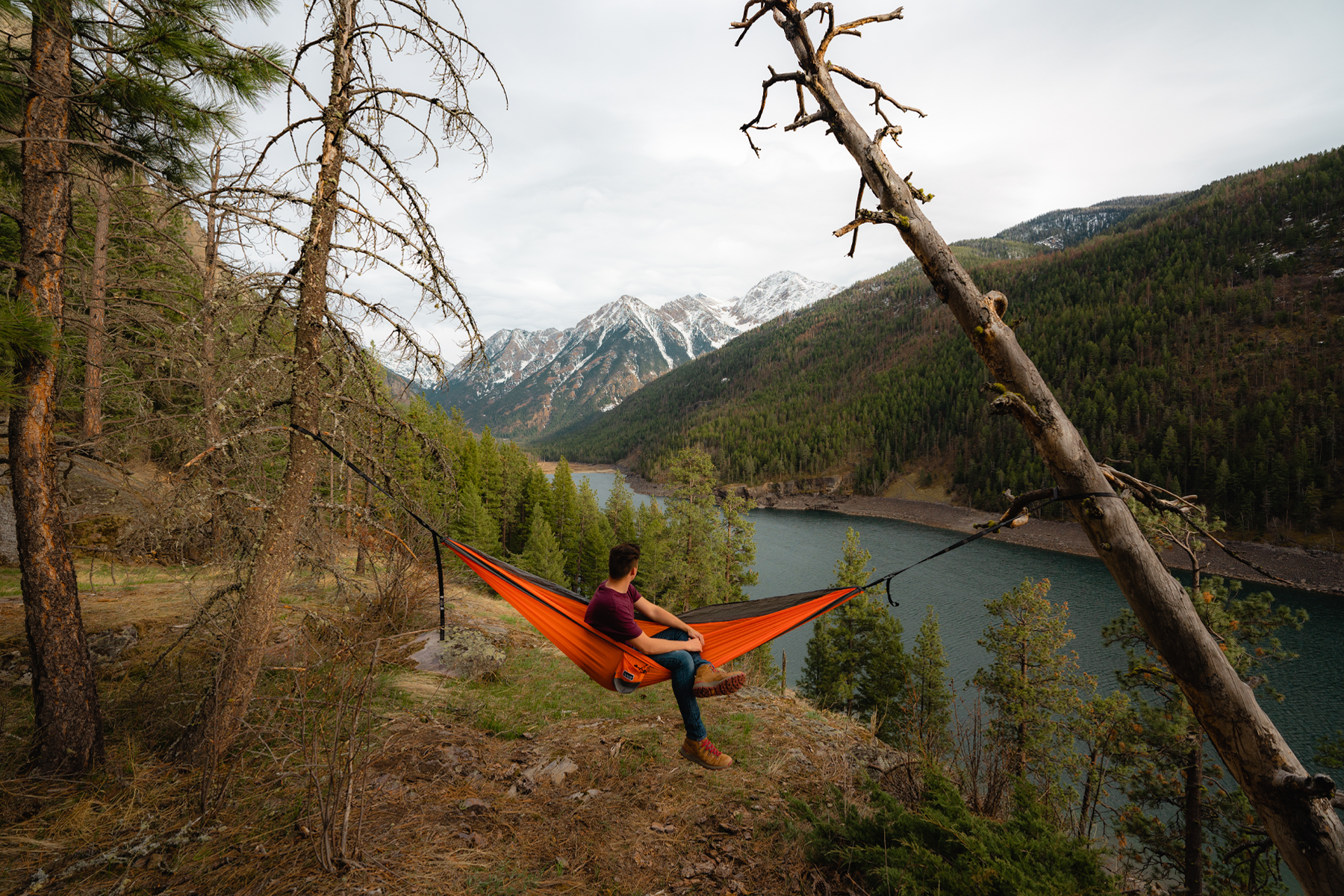
Camping and outdoor accommodation sit at the very low end of the emissions spectrum, which is one of the reasons we're fairly enthusiastic advocates for it. Sleeping in a tent or stringing up a https://nakie.co/collections/hammock-collection between two trees generates a fraction of the emissions of even a modest hotel stay (and the views are usually better too).

-
Pack lighter than you think you need to
Aircraft fuel consumption increases with weight, and while one person's overstuffed bag isn't going to move the needle on its own, the cumulative effect of travellers packing lighter across millions of flights is well documented.
Beyond reducing carbon emissions, a lighter pack is just a better way to travel, with no checked luggage fees, no carousel anxiety, and no hauling a massive suitcase up four flights of stairs in a guesthouse at midnight.
This is why we make our gear as lightweight as possible. Our hammocks weigh 600g and pack down to the size of a water bottle. Our sand-free beach towels are made from 28 recycled plastic bottles each and replace the bulky beach towel you'd otherwise stuff in your bag. Our outdoor puffy blankets compress to the size of a wine bottle and keep you warm down to 5°C. One piece of kit = multiple uses = significantly less total luggage.

-
Participate in carbon offset programs
Carbon Offsetting: What It Is and What to Look For
Carbon offsetting means compensating for emissions you can't eliminate by funding projects that reduce or remove an equivalent amount of CO₂ elsewhere, like reforestation, renewable energy development, methane capture, etc. It's not a substitute for reducing your footprint at the source, but for the flights you're going to take, regardless, it can be a meaningful and worthwhile thing to do.
The catch is that offset quality varies enormously, and a lot of schemes are better at marketing than they are at actually sequestering carbon. Look for programs verified under Gold Standard or Verified Carbon Standard (VCS).
In terms of cost, you're typically looking at $10–$30 AUD per tonne of CO₂e through a reputable provider. That Sydney to London return at 4 tonnes would cost somewhere between $40 and $120 to offset fully, which, for most people, is considerably less than the duty-free spend on the same trip!
How We Reduce Our Carbon Footprint at Nakie
Our whole brand is built around being kinder to the planet and protecting the wild, precious places that make travel worth doing in the first place. That shapes everything we do – from how we make our products, to what we make them from, and what we do with every purchase.
Every Nakie hammock is made from around 37 recycled post-consumer plastic bottles, each puffy blanket uses 54, and our beach towels divert 28 bottles each from landfill. Our packaging is plastic-free and everything comes with a lifetime warranty, because a product you never have to replace is, by definition, the most sustainable one.
The thing we're most committed to, though, is reforestation. We plant 4 trees for every item purchased through verified reforestation projects in Kenya and Madagascar that employ local communities, and we've now planted over 1,087,503 of them.
Trees are one of the most effective tools in the fight against climate change. Through photosynthesis, they draw CO₂ from the air and lock it away as wood for decades, while also stabilising soil, purifying water sources, controlling erosion, and creating habitat for wildlife. Large-scale reforestation won't single-handedly solve the problem, but it's one of the few carbon removal strategies that works at real scale right now and delivers a stack of other benefits alongside it.
We want future generations to have the same chance to explore the world the way we do. Planting trees with every purchase is one concrete way we're working towards that.
→ Read our mission statement here
Wrapping Up
The world is full of places worth protecting and even more worth exploring, and the good news is, those two things aren't mutually exclusive. None of the tips we’ve provided asks you to give up travelling – they ask you to be more conscious about your choices. It's not a huge ask – and the planet (and your future self, hauling a carry-on through a European summer) will thank you for it.
Related reads you’ll love:
-
Carry-On Packing Guide: How to Travel With Only a Carry-On Backpack
-
8 Sustainable Beach Essentials if You Love a Beach Day (And the Planet)
FAQs
Is it better to book direct flights or does a stopover matter?
Direct flights are almost always the greener option. The majority of a flight's fuel burn happens during takeoff and climb, so every additional leg of a journey adds a disproportionate amount of emissions relative to the distance covered.
A direct Sydney to Singapore flight will have a lower footprint than the same route broken into two hops – even if the total kilometres look similar on paper. If a stopover is unavoidable, a longer layover where you're not rushing to catch a connection is marginally better than a short one, since it usually means a more fuel-efficient cruising altitude on each leg. But when direct is an option, take it.
Do newer airlines or aircraft types produce fewer emissions?
Yep! Newer aircraft like the Boeing 787 Dreamliner and Airbus A350 use roughly 20–25% less fuel per passenger than the older widebody jets they've replaced, thanks to lighter composite materials, more efficient engines, and better aerodynamics. Airlines that have invested in modernising their fleets will generally have a lower emissions intensity per flight than carriers still running older equipment.
What's the carbon footprint of a domestic flight vs driving the same distance?
It depends on the distance and how many people are in the car, but driving is usually the lower-carbon option for trips under around 500km – especially if there are two or more people sharing the vehicle.
A solo driver in an average petrol car produces roughly 170g of CO₂e per kilometre, while a domestic flight produces somewhere between 150–255g per passenger kilometre once you account for the full climate impact of flying at altitude.
The maths shifts pretty quickly once you add a second person to the car, which halves the per-person footprint. For longer distances, the gap narrows. And if you're driving an EV, it's not really a contest.
What's eco-tourism, and is it legit?
Eco-tourism, at its best, is travel that actively supports conservation and local communities rather than just consuming a destination. Think small-group wildlife experiences run by local guides, accommodation that funds habitat protection, or tours where a portion of what you spend goes directly into protecting the place you're visiting.
At its worst, it's a marketing label slapped on a resort because they have recycling bins. The term itself has no regulated definition, which is part of the problem. The way to tell the difference is to look past the branding and ask concrete questions: who owns it, who works there, where does the money go, and is there any third-party certification behind the claims?
Organisations like the Global Sustainable Tourism Council (GSTC) and Rainforest Alliance certify operators against real standards. If an "eco" experience can't answer basic questions about its community or conservation impact, it's probably more "gram" than "green."